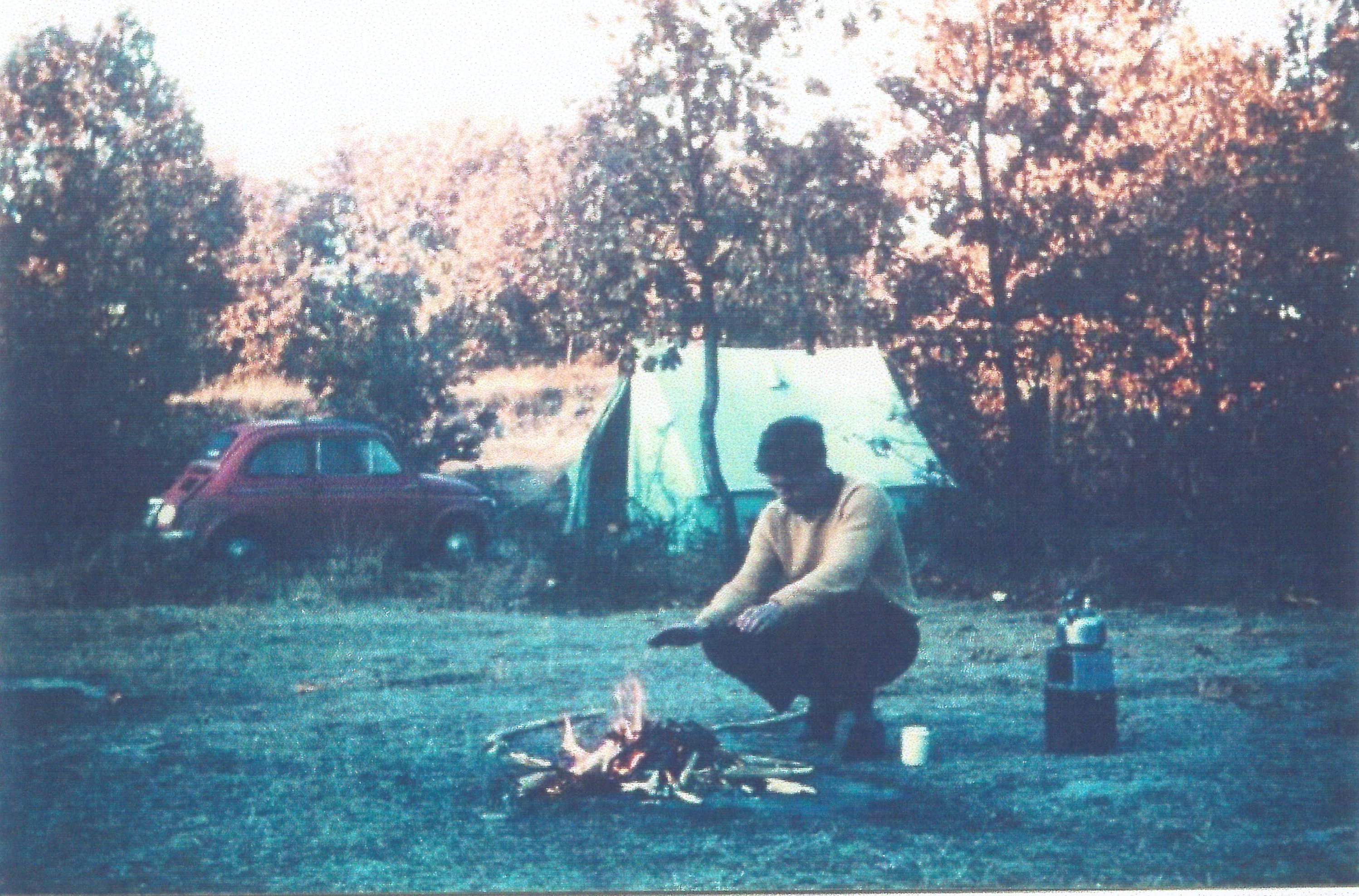
6am. Well, the police didn’t get us after all! It’s a lovely, sunny morning. A little chill in the air. To take the chill off I.1lit a fire in the clearing. I got Allan to take my photograph to show my off my “beard.” I had sworn not to shave until we had reached Athens. Some beard! Reminded me of many years ago when I was, playing cornet in a brass band in. Yorkshire. I was about fifteen years old. I had a friend, Albert Riley who played excellent flugel horn. Albert was very handsome and world-wise, and I looked up to him. On the day of the Queen’s coronation, we had been playing in the streets when the rains came down. While we were sheltering in a pub – ideal for the older members of the band, I asked him if I needed to start shaving. He examined my face and then laughed. “Why, it’s nowt but bum fluff, lad,” he declared to my utter mortfication. And I thought I was ready to join the man class!
Back to Yugoslavia…
Allan and I sat in front of the fire, enjoying its warmth and a cuppa tea – very satisfying! I had spent a comfortable night. It was to be expected after all the precautions I had taken. Allan had done the same. On the bare canvas of the bed – it was always coldest there, I had placed two towels, a woollen shirt my corduroy trousers and one half of my blanket. On top of this came the sleeping bag; the middle of the sandwich, so to speak. From the bottom I brought up the other half of the towel, and to cap it off, I placed my raincoat over it all. I slept in my sweater, pyjamas and socks. Very cozy! We hope to be on the road by eight o’clock now that the nights come in earlier. Early to bed and early to start is the new rule. This life must be suiting me – I feel strangely fit! For the first time on- this trip, I take out the sunglasses.
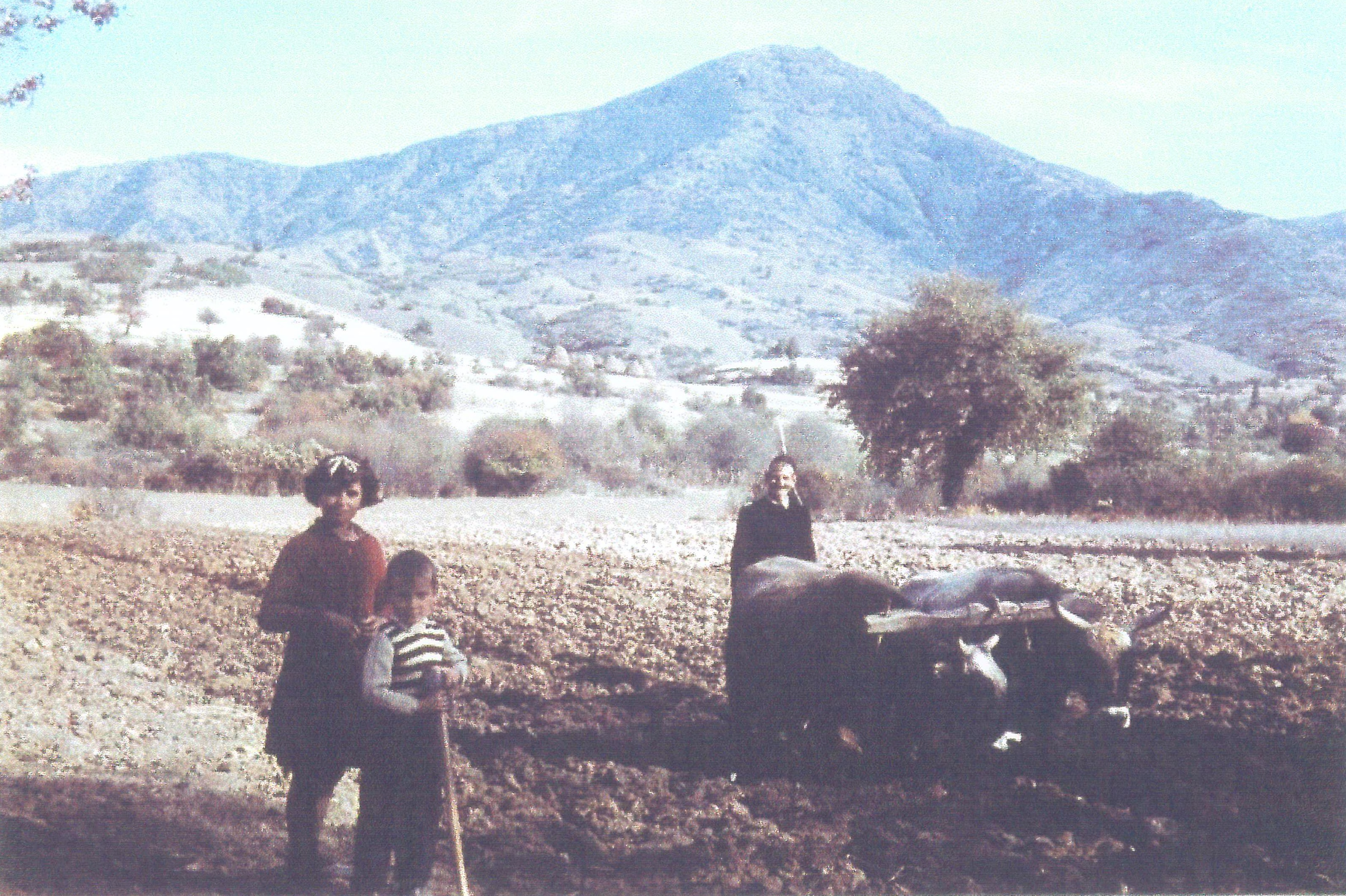
8am. We are on our way. The road is a little bumpy but not too bad. Our main problem is avoiding the numerous oxen and horse-driven carts. This part of Yugoslavia is much more cultivated than the north; much of the land is under the plough.
Driving through the town of Paracim was rough on the car, the roads were awful! But shortly afterwards we found another Autoput and were able to make good time to Nis. The people here and the way they live reminds me of another of my interests – the Wild West. At intervals along the Autoput we passed gangs of workers undertaking big jobs by hand which we would not dream of doing without machines. For instance, and try to imagine the scene.
They are making a cutting through solid rock, glaring yellow in the sun, the dust swirling around. As the rocks are dislodged by pickaxe, workers gather them up to fill baskets which are then carted away. By our standards, very primitive indeed.
The city of Nis. Here we met a lady who spoke English. She told us they had not had rain for three months. And in such conditions they are building a motorway!
We were hungry! A baker’s shop looked inviting. On display they had what looked to us to be apple pie. Mmm! Four pieces please. Eagerly, we bit into them – ugh! It was cheese! And to our civilised(?) taste buds, it was inedible. Two little peasant girls were looking at us curiously as they regarded our reaction. It must have been like Christmas to them when we presented them with the apple pies which they devoured with much gusto!
We find we are the centre of attraction here. If we try to speak to one person, several more drift over to see what is going on. We decide we might as well make the most of it; because we will never experience it anywhere else. I think I / would like to be a film star!
Nis is behind us. Apart from a small mountain range to the east, there is nothing interesting to be seen. We are getting used to mountains – blasé! It is very warm in the sun; we have the roof open. The roads-.are deserted and we think it must be quite an occasion for the villagers when we speed by. We are still on the Autoput – but not for long.
a Soon, construction forces us onto a narrow “diversionary” road worse than a cart track. I was afraid the car would not stand up to it – really afraid! But I needn’t have worried. In later years, the Americans whom I met would call it a “washing machine.” But like a washing machine, it kept on going and going.
We get back onto the completed side of the new road. At intervals we keep meeting groups, or rather regiments of road workers, marching military style down the half-completed Autoput, singing and waving red banners and national flags. Happy, smiling workers who stop and wave to us as we pass. There are even girls working alongside the men, doing the same jobs. English girls, take note!
Every few kilometers we pass camps of temporary buildings which are the road workers’ camps. Then the Autoput ran out!
We had to take to the bad roads again. Most of the road to Skopje – the scene of the terrible earthquake, was almost impassable. People used to English roads. – which reflect the English way of life, cannot begin to imagine what it is like.
For two hundred kilometers (125 mls.) we drove at little more than a walking pace. Later, I was informed that the bad state of the roads was due to the retreat of the German tanks from Greece during World War II, literally tearing up the roads as they went. At one point we even had to make a diversion from a diversion. One of these diversions led us through a small town where the arrows directed us through what seemed like people’s back gardens! Roads? No – merely baked clay!
The diversion at last brought us back to the “main road.”
But it was about six feet above our present position. In order to gain the height, we had to drive up narrow planks set up for that purpose.
The bad road went on and on interminally. I sat there in trepidation, waiting for the car to pack up. No! I was wrong again. Was the car enjoying itself? We were continually passing peasants on their way to market(?) riding on ox carts, pony traps or even donkeys.
Approaching Skopje, the road improved somewhat. Unfortunately, we did not see much of the city, the- road skirting the town as usual. But we are certain it will be like most of these south Yugoslav towns. Tree lined streets, almost empty of cars; the shops, dull and uninteresting.
Nothing to warrant a stop.
The road out of Skopje began to climb. Several miles went by and then without warning, the engine seemed to lose power and then pick up again. It was not the first time. It had happened before, way back. But this time we stopped to try and find the root of the problem. I was also curious to see if the bumpy roads had caused any damage. We pulled to the – Side of the road. Fortunately, the car was in good shape. Neither could we find any obvious fault with the engine. However, we noticed a brake cable split pin had jumped out, and the oil pressure lead had come off. The oil lead contact appeared to be broken so there was nothing we could do there. The brake cable was easily repaired with a piece of strong wire. The engine is still running well and ostensibly there is nothing wrong with it. Allan is lying there, trying to puzzle it out 1 but there is nothing we can do until tomorrow. Personally, I don’t think there is much wrong. But seeing as I don’t know much about cars, that statement doesn’t mean much.
We are camped on a small plateau about five to ten feet above the road. The night, which falls very quickly here is still and warmer than last night. But I am taking no chances, and am bundling up. Allan is already fast asleep as I write this. The bumpy roads have taken their toll and we are both very tired. What awaits us tomorrow we do not know but there is no point in worrying. By the way, this is the end of the first week and what a week it has been!
As a reminder to myself, we are now in the heart of Macedonia, the land of Alexander the Great. Goodnight.
Speedo reading: 15390. 233 mls. (1846)