Had a very good night for a change. As I said, we went to bed at eight o’clock, and except for being briefly wakened up by the wind, slept until seven in the morning. That was when a great blast on a siren woke us up. I still don’t know what it was. Calling the faithful to Mass? However, to have had nearly eleven hours sleep was a real treat.
The wind is nearly gale force, so I’m afraid that cuts out any trip to Capri. But it is dry, and the cloud cover not so heavy. We should be able to carry out the rest of the planned program.
Went for a shave – my! The wash bowls are out in the open, and the running water is cold! We have washed out in the open before, but this is a bit chillier than usual. The shave just about took the skin off my face and lasted about twice as long as usual. Talk about back to nature – brrr!!!
9 pm. What a day! Commercial art, practical history, rain, fantastic scenery; everything one could wish to experience – and all in one day! But first, like all narrators, I should start at the most logical place – the beginning.
The wind was still strong as we set out, hopeful that the rain would stay away. We were driving along a broad road on the Naples sea front. On the one side, the Mediterranean with cloud shrouded Capri in the distance. On the other, large apartment blocks. On nearly every balcony, washing was hanging out to dry.
Suddenly, a well dressed gentleman, accompanied by a young man waved us down. First, and without being told, he explained the best way to get to Pompeii – how did he know? Then he politely asked us if we could give his son a lift to work. Apparently his own car had broken down. Naturally we consented. The boy, who appeared to be about seventeen or eighteen got in and off we went.
The young man could speak pretty good English. His place of work was a cameo and coral factory at a town called Torre del Greco. As Christmas neared, the factory began to work seven days a week, which explained why he was thumbing a lift on a Sunday.:His father was the foreman of the factory, and his grandfather the owner. It is a craft which is passed on through generations. One day, he himself will inherit the factory. Some interesting facts emerged from the ensuing conversation. First, that all the bridges over Autostrada on which we now travelling and indeed, all the paved streets of Naples were made out of the lava from Vesuvius. They also use this lava at his factory to carve cameos, cufflinks and so on – which I didn’t know. Also that Vesuvius buried – Pompeii in AD 79 and last erupted in 1944 – which I did know.
We reached his small factory where he invited us in. He had to start work right away but introduced us to a lady whose job is solely to show visitors around and try to sell them some of the products. We were taken into a workshop where three or four craftsmen were busy at work.
She explained that they use three kinds of shells used in making the carved corals. Actually they are the same kind but with different coloured insides. The shells have three layers. The top one is useless so it is filed off. The remaining two layers are then cut to a circular shape, stuck on the end of a stick which is then placed in a vice. A design is drawn on the shell. The part of the shell outside the design is scraped away leaving a miniature frieze. Very difficult and very artistic. It sometimes takes five years to train a craftsman before they are considered qualified. Others were shaping the lava into various “objets d art.”
Afterwards we were taken into the showroom where tray after tray of some of the most beautiful work I have ever seen were displayed before us. Bracelets, necklaces, earings etc. All marvellously shaped and designed. It nearly broke my heart at not being able to buy something for Joan, but they were just too expensive. Maybe next time! Allan bought a bracelet and a necklace for about £5 ($7.50). But he had more to spend than I. I had just enough to get me through.
However, I thought that if I have come so far at my age, then I am sure I am not going to spend the rest of my life confined to Jersey. Next time I come here, it will be with the only one I shall want to be with. No slight against you ' Allan!
Next stop Pompeii which I could hardly wait to see. All my life I have waited for the chance to visit it and now at last it was here.
Entrance fee was L.75 (1/- or 10¢) but I would have paid ten times that amount.
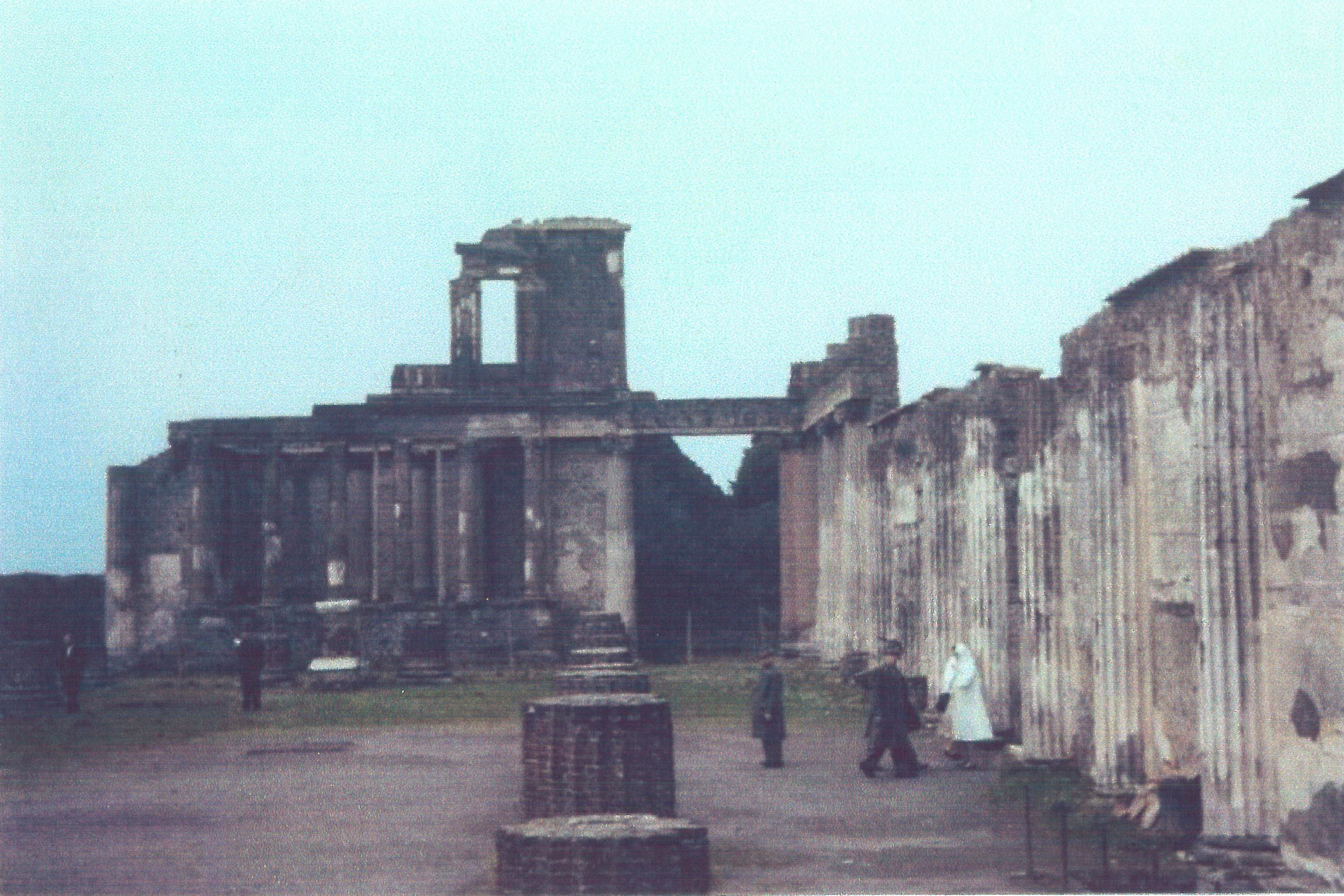
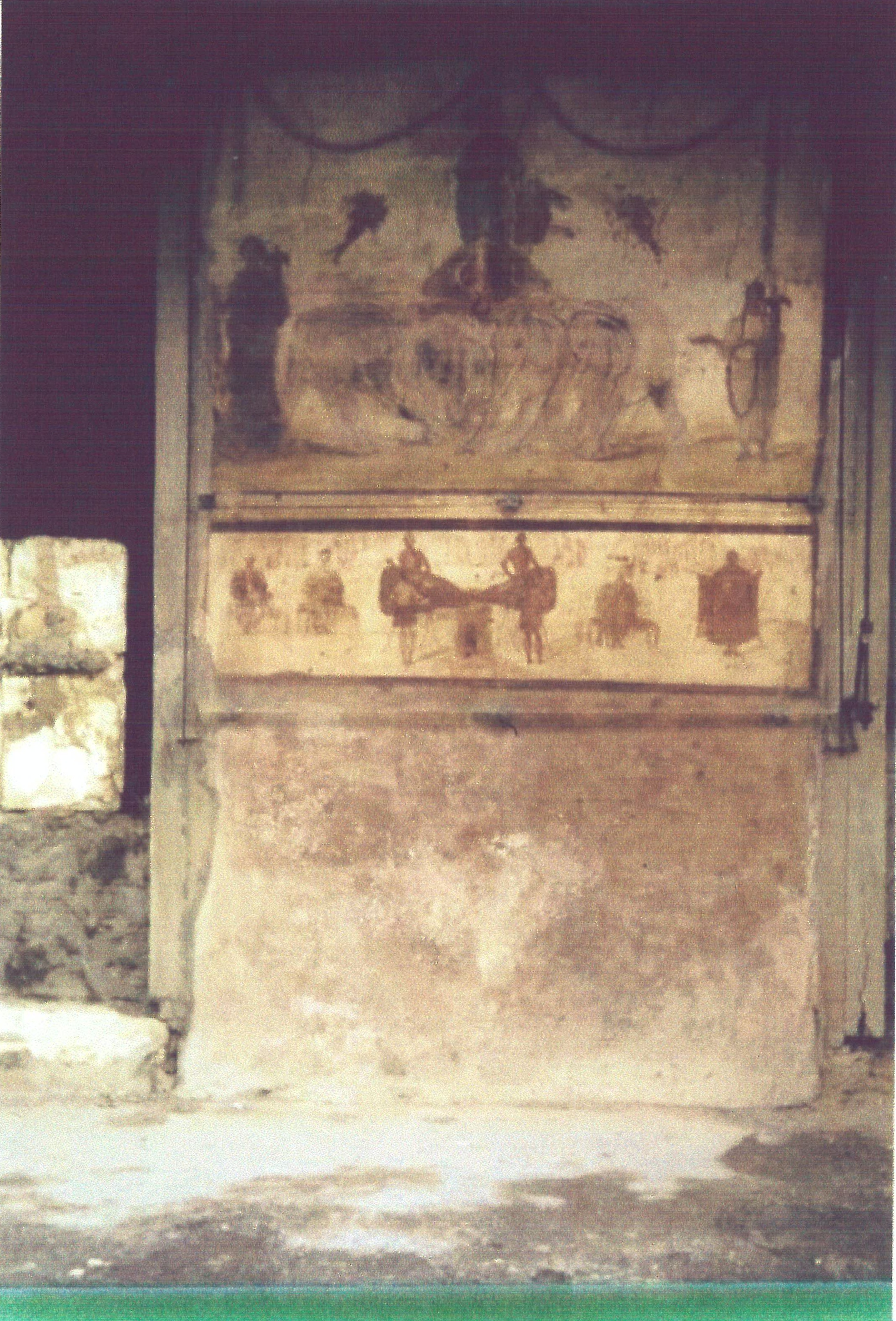
Pompeii did not instill in me the same kind of wonder that the Acropolis did. But it is still remarkable in its size. Historically speaking, it is probably more interesting for it has not felt the ravages of time and conflict that the Acropolis has due to the simple fact that it was buried until the last century when excavations began. Life here stopped at one precise moment and from that moment was petrified for all time.
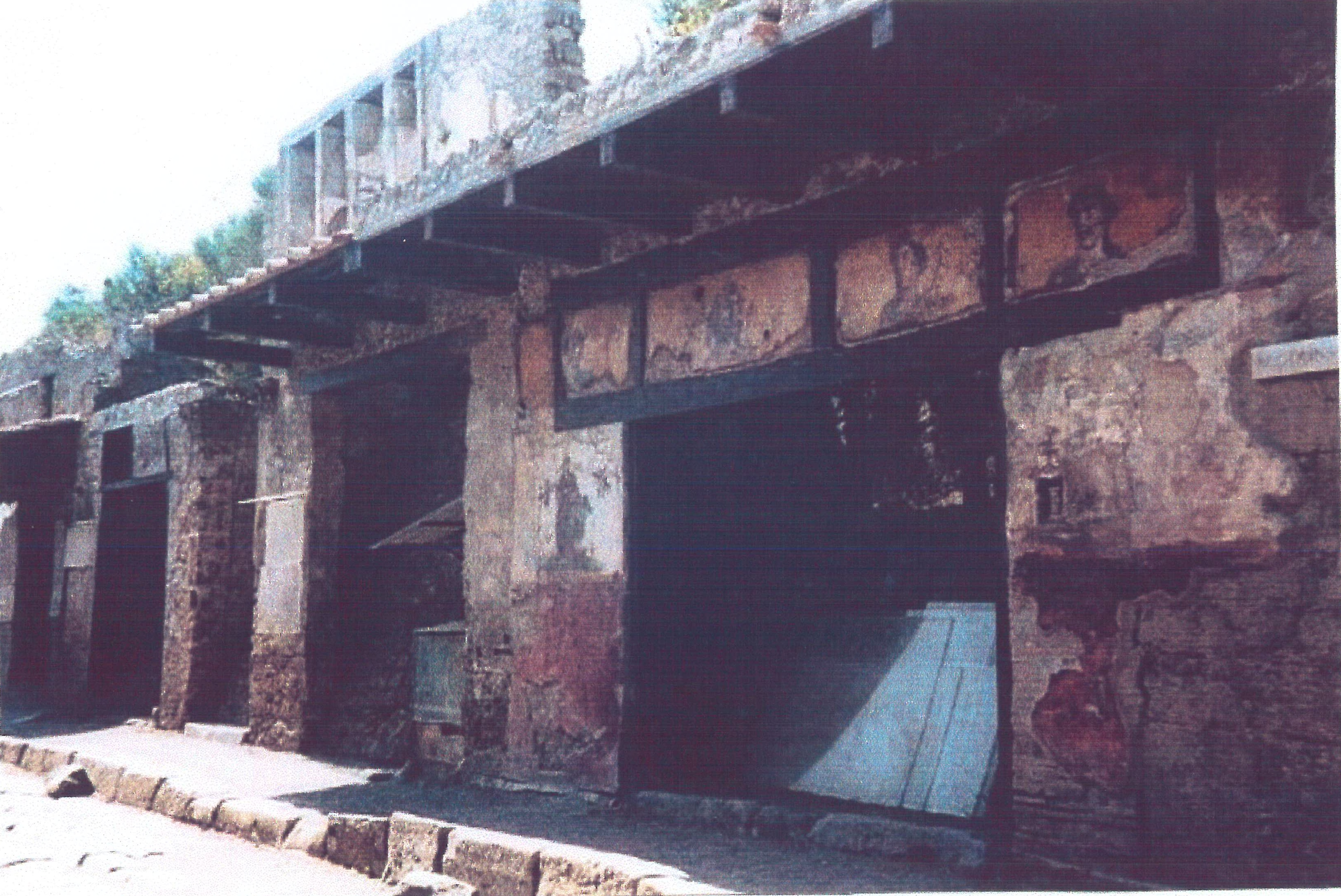
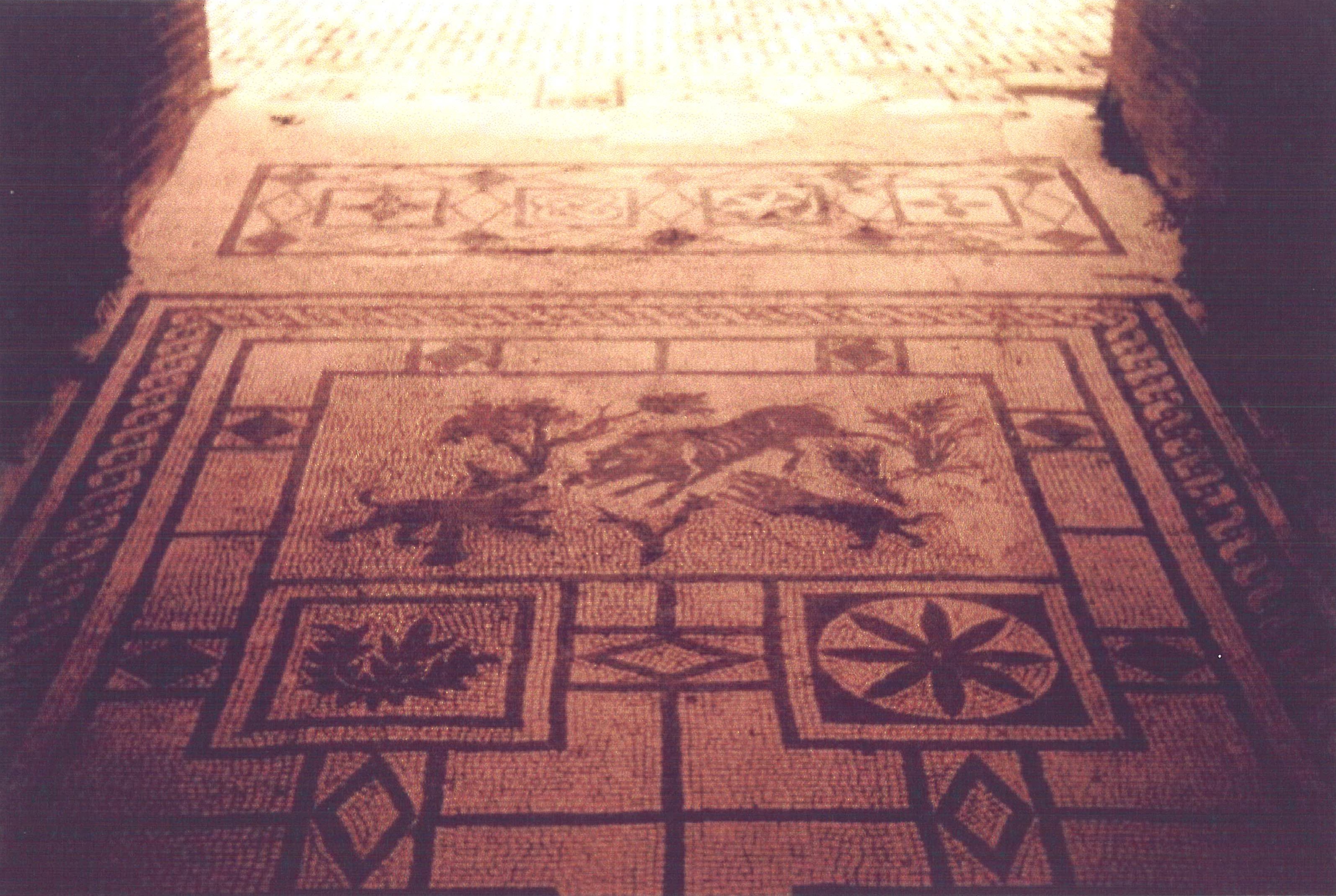
The houses, with their frescos and mosaics were still there, almost intact. In fact, in order to get a good photograph of a mosaic in the garden, I climbed over a small gate to stand astride the picture of a man’s face. One of the attendants nearly had a fit when he saw me – and quite rightly so! I was standing on two thousand years of history, seemingly not caring a damn.
There weren’t many tourists at that time of the year. We were able to walk unhindered down the ancient streets in between the grooves made by the chariots’ wheels so long ago. Just imagine. “Do you know what speed you were doing? – Let me see your driving license!”
One can still see the bars whose walls are marked by the graffiti of the soldiers who frequented the place. I think all the roads lead to the ampitheatre and the forum in the middle of town. Fascinating! Pompeii – and I must say this, is in better condition than some of the Greek towns we passed through!
A few historical notes: Pompeii was not flooded with lava, but drowned in a poisonous and deadly mixture of hot ashes and sulphur fumes. That was the major cause of the high death rate. The town was covered in ash to a depth of twenty-four feet. When excavations began, the cavities in the solid ash were filled with plaster. When opened, the plaster had formed a perfect cast of the body of the unfortunate beneath. Some of them, including a dog can be. Seen in the museum which stands on the site.
It was in this museum, whilst sheltering from the heavy – rain we ran into two of the American lads we had met on the boat from Greece. A discussion on our two standards of living began. One of them was of the opinion that life in Britain was not far removed from the Stone Age. He even had the audacity – or ignorance, to ask Allan if the water we used was drawn from wells! What a laugh! Even now I don’t know if he was serious or not.
Unfortunately, the heavy rain cut short our visit. One could come here day after day and not tire of it. The weather also made photography virtually useless. Continue seemed to be the best idea.
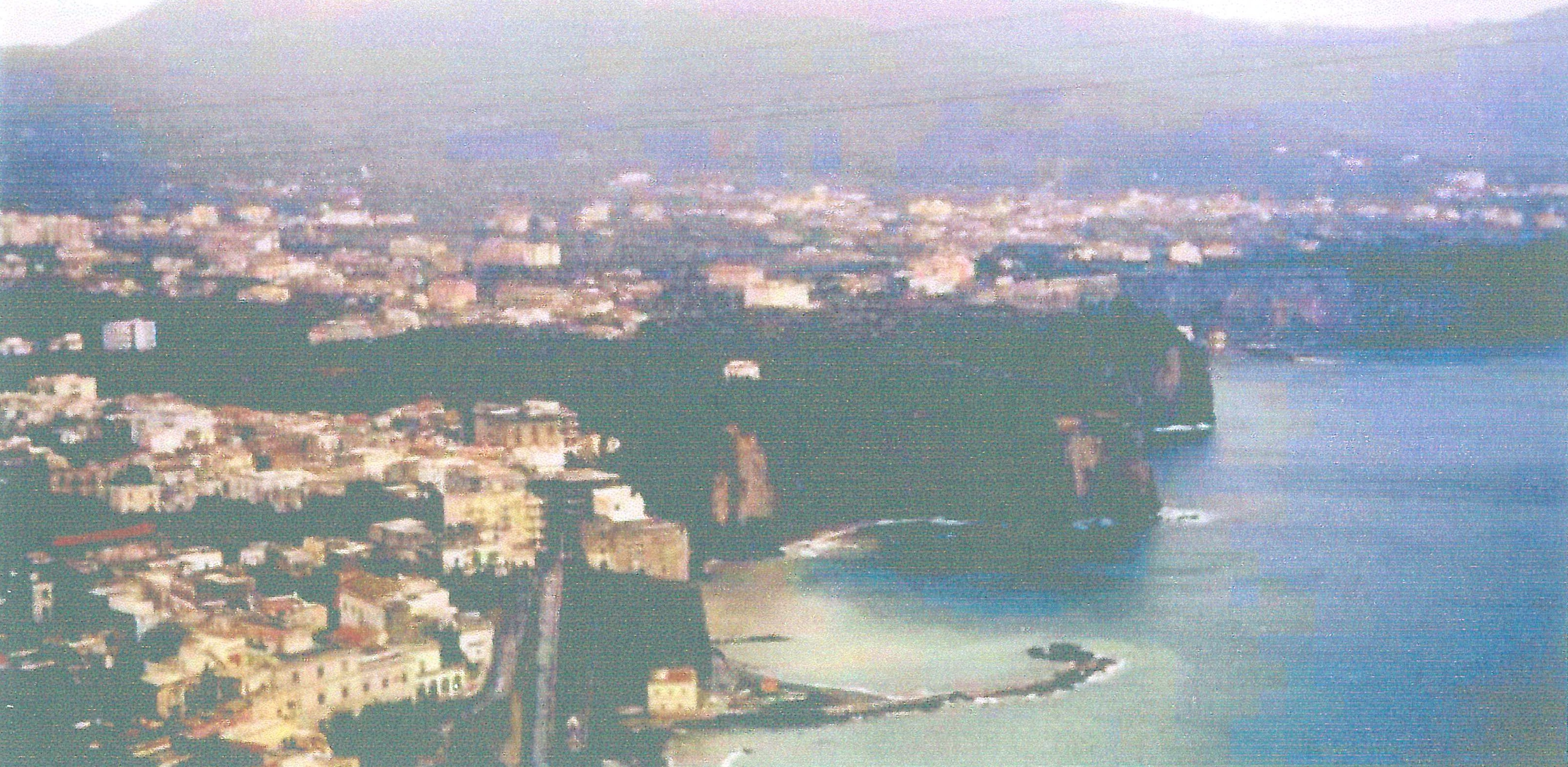
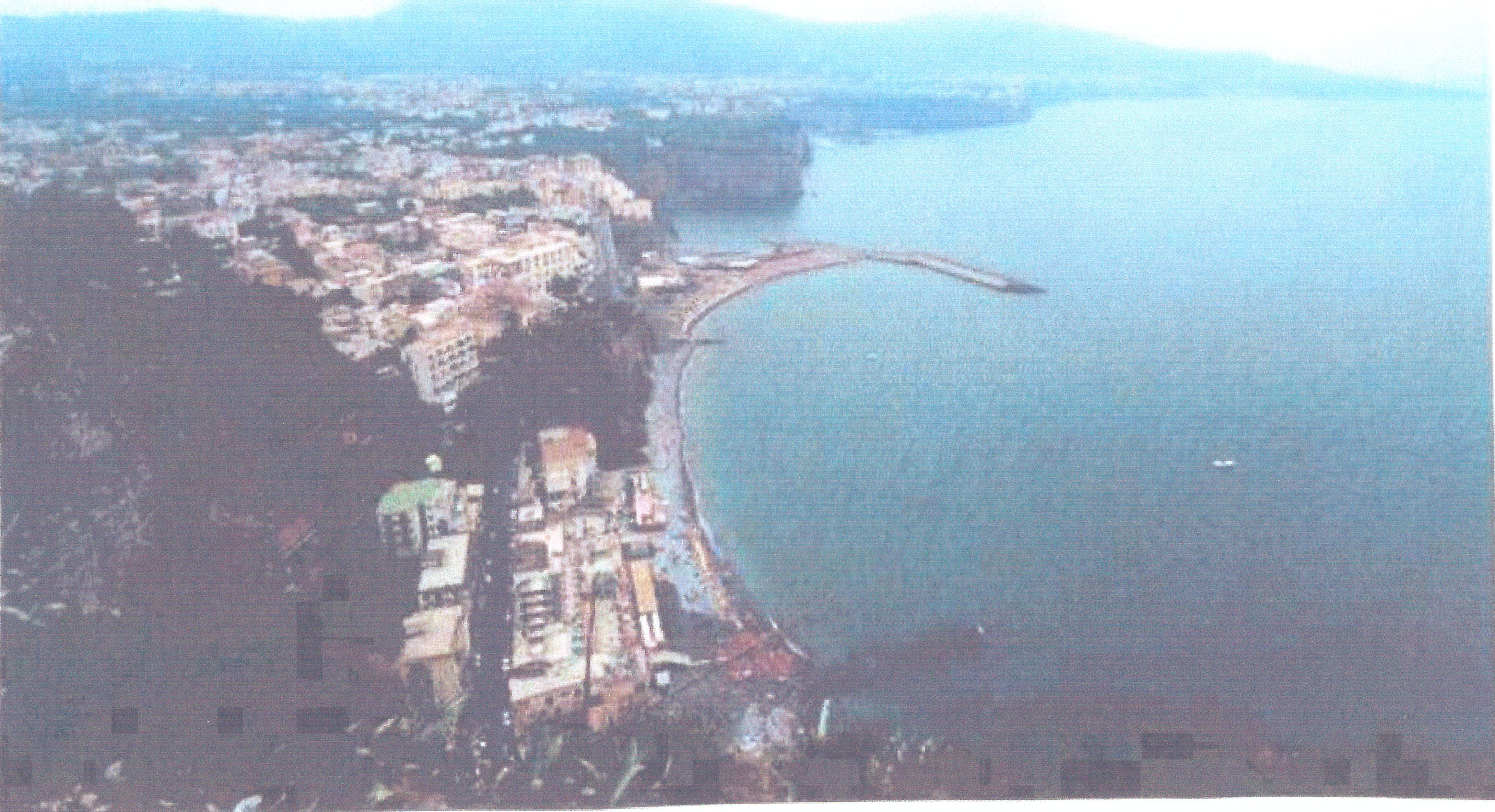
Appreciation of the Bay of Naples was also hampered, but not completely. After all, this is the Bay of Naples. The rain began to taper off as we neared Sorrento, enabling us to take some photos. Even in the bad conditions it is easy to why they are called picture postcard resorts. Only thing is, they are more beautiful than any card; they simply defy description, and I fell in love with them! I must come and spend a holiday here – so perfect. High cliffs, picturesque houses perched on then, defying natural laws, blue seas etc. etc. ad infinitum!
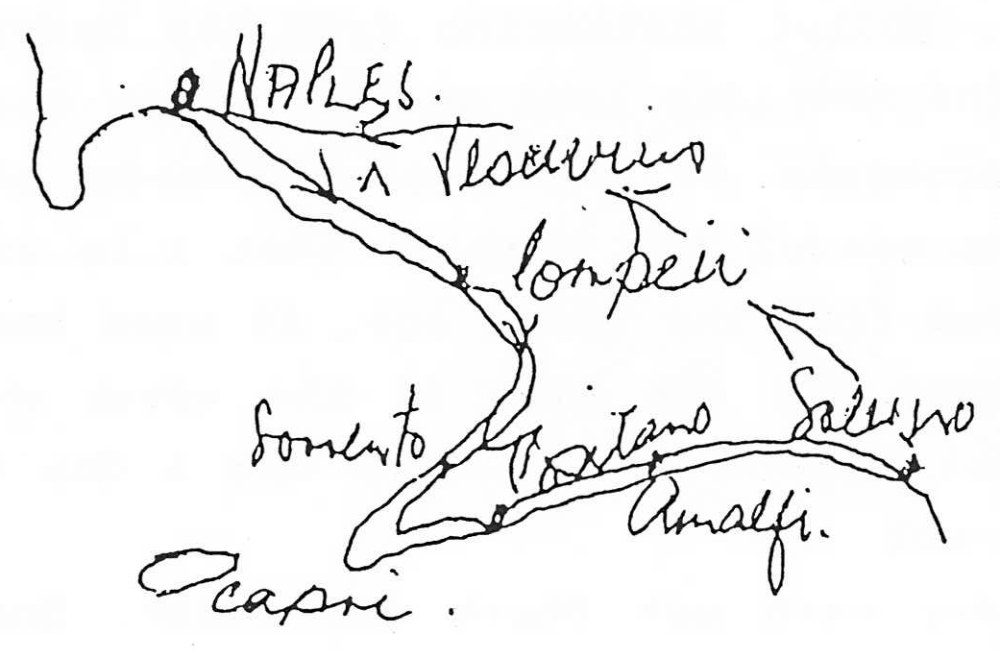
On rounding the headland (see map) we caught a glimpse of nearby Capri, now shrouded slightly in mist.
We were now headed for Positano by way of an impossibly twisting cliff road constructed halfway up a cliff, like a step in a giant’s stairway. A dizzy two hundred feet below, the wind driven sea slapped noisily onto the narrow beach.
Positano defies description. If you can imagine a town whose founders started building at sea level only to run out of space. Those founders then decided the only way to go was up. So up they went, clinging to the cliff side. My little drawing may give some idea of Positano’s founders’ ideas.
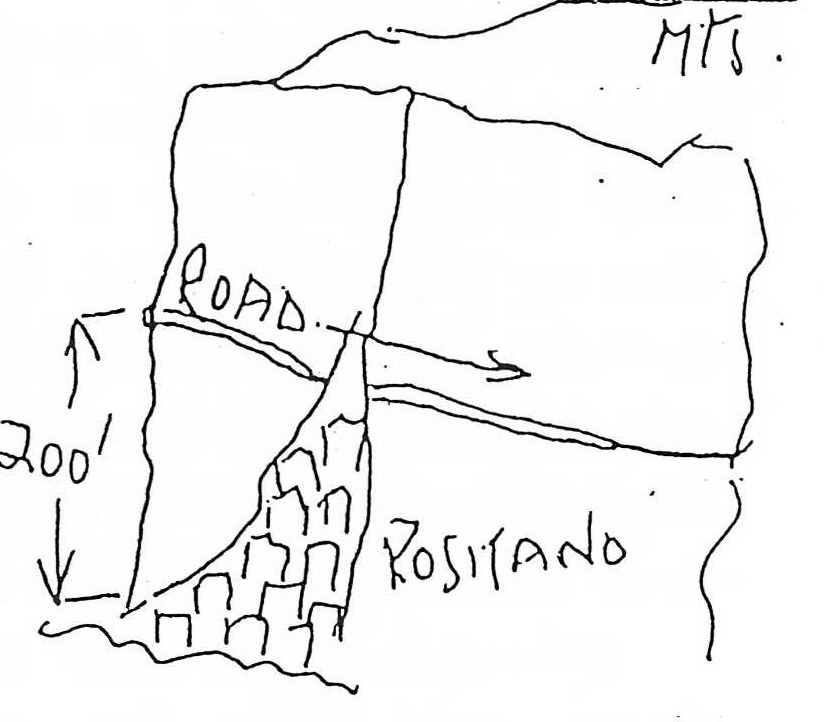
The road never climbed nor dropped but simply followed the contours of the cliff. There was no other way to do it unless of course, they had built tunnels through the rock face. Twisting in and out, in and out, not a road for those with weak nerves or no head for hights. It was blowing a gale too, adding to the hazards.
Had we known what was in store for us, I doubt we would have attempted it all in one go. But ignorance is bliss, so we carried on. I was driving and getting more than a little fed up for now the dark was coming in, blanketing out any views that were to be had. It was now simply a matter of drive, drive, drive to Salerno – the scene of the Allied landings in World War II.
Once at Salerno we joined the Autostrada to Napoli with nothing more to worry about – or so we thought.
As Naples drew closer, the lightning flashed so often and with such intensity that the whole of Vesuvius could be seen silhouetted in the background. The rain intensified to such an extent that it was impossible to see more than ten yards ahead. The light from my headlights was being reflected back into my face, adding to the danger.
The Autostrada was now flooded at regular intervals, forcing cars to drive at walking pace. Running into great pools of water is like suddenly jamming on the brakes. Cars, incapacitated by the water driven into their carburetors lined the road. Luckily, our engine, being in the rear, we did not suffer the same fate. Never in my life, and never again I hope, have I been out in such a storm. In Athens at least we were abed. I nearly had an accident at 50 mph. I didn’t see a car filtering in from an on ramp, and had to swerve at the last moment. That shook up my nerves for a while.
Nearer Naples, the rain stopped. But the next worry was, is the tent still up? Incredibly it was, and dry, So we were able to go straight in and cook a meal.
It is now eleven o’clock, and I’m getting tired of writing. But as I said at the start, “What a day!” It is still raining. What did we do to deserve this? Ah well, Rome tomorrow – do or die! Goodnight. 2
Speedo reading: 16884. 129 mls. (3340)